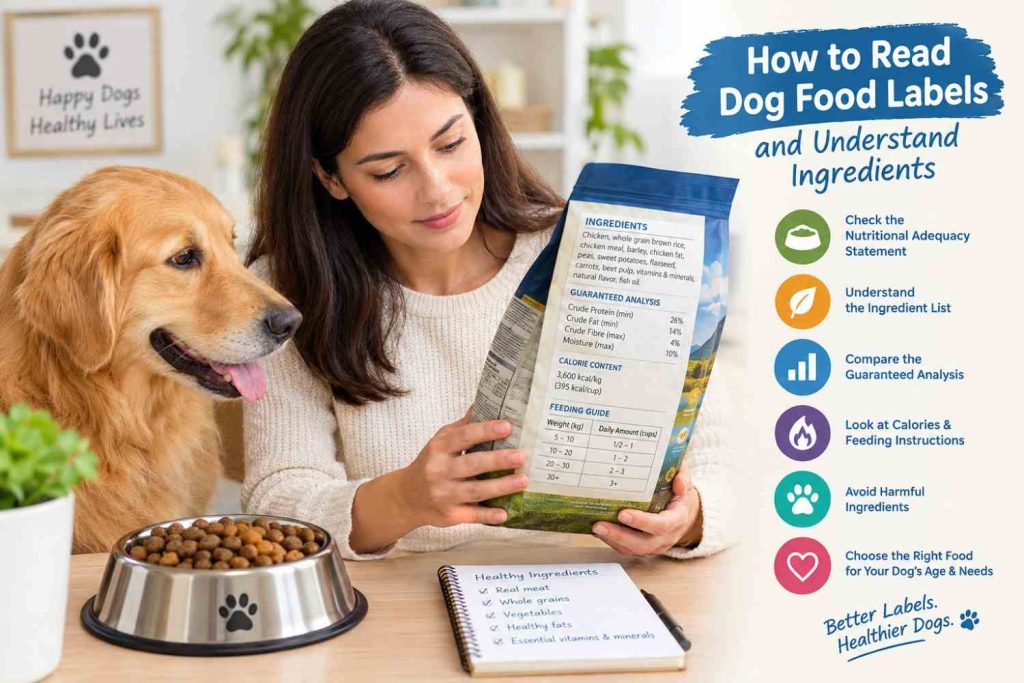
Choosing the right dog food can feel confusing when every package promises better nutrition, healthier skin, stronger muscles, or a shinier coat. However, the most important information is often printed in small letters on the back of the package.
Learning how to read dog food labels helps you understand what you are feeding your dog, compare different products, and choose food that meets your pet’s nutritional needs. Instead of relying only on attractive packaging or marketing claims, you can make informed decisions based on ingredients, nutrient levels, feeding instructions, and your dog’s age and health.
In this guide, we explain how to read dog food labels, understand common ingredients, and identify the details that matter when choosing everyday food for your canine companion.
Why Is It Important to Read Dog Food Labels?
Dogs need a balanced combination of protein, fats, carbohydrates, vitamins, minerals, and water to support their overall health. However, not every dog has the same nutritional requirements.
A growing puppy needs a different nutritional balance from a senior dog. Similarly, highly active dogs may require a different energy intake from dogs that spend most of their day indoors.
Reading the label helps you:
- Understand the main ingredients in your dog’s food.
- Check whether the food is suitable for your dog’s life stage.
- Compare protein, fat, fibre, and moisture levels.
- Identify calorie content and recommended serving sizes.
- Recognise marketing claims that do not tell the whole story.
- Choose food that suits your dog’s individual needs.
The goal is not to find a product with the longest ingredient list or the most impressive claims. It is to find a nutritionally appropriate food that your dog can eat safely and consistently.
1. Start With the Nutritional Adequacy Statement
One of the first things to check when learning how to read a dog food label is whether the product provides complete and balanced nutrition.
A complete and balanced food is formulated to supply the essential nutrients required for its intended use when fed as directed. In the United States, nutritional adequacy statements may refer to AAFCO nutrient profiles or feeding trials. Other countries may follow different regulatory and labelling systems.
Look for wording that identifies the food as suitable for a particular life stage, such as:
- Puppies: Food formulated for growth and development.
- Adult dogs: Food intended for adult maintenance.
- All life stages: Food formulated to meet nutritional requirements across specified life stages, subject to the product’s stated suitability.
For example, a puppy food should meet the nutritional requirements of growing dogs. Choosing adult-maintenance food for a growing puppy without veterinary guidance may not provide the appropriate nutrient balance.
Also, distinguish complete meals from complementary foods, toppers, and treats. Products labelled for intermittent or supplemental feeding are not intended to serve as the sole diet unless specifically directed by a veterinary professional.
Practical tip: Check the nutritional adequacy statement before comparing flavour, packaging, or price. It helps establish whether the product is appropriate for your dog’s basic nutritional needs.
2. Understand the Dog Food Ingredient List
The ingredient list explains what goes into the food. In many regulated markets, ingredients are listed in descending order by weight when they are added to the formula.
This means the first ingredient weighs more than the ingredients listed after it at that stage of production. However, the list does not show the exact percentage of every ingredient or automatically reveal the finished food’s nutritional quality.
Animal protein sources
Chicken, fish, beef, lamb, and other animal-derived ingredients can provide protein and essential amino acids. Protein supports muscle maintenance, tissue repair, and normal body functions.
You may also see named meat meals, such as chicken meal. These are concentrated ingredients produced by processing animal tissues to remove much of their water and fat. They are not automatically inferior to fresh meat.
Fresh meat contains substantial water, so it can appear high on the ingredient list before processing even though its weight decreases during cooking.
Grains and other carbohydrate sources
Rice, oats, corn, barley, and wheat can supply energy and other nutrients. Properly formulated dog foods can include grains as part of a balanced diet.
Sweet potatoes and other carbohydrate sources may also contribute energy and fibre. Their presence does not automatically make a food better or worse.
Unless your veterinarian identifies a specific dietary requirement, there is generally no reason to reject a food simply because it contains grains.
Vegetables and fibre sources
Carrots, pumpkin, beet pulp, and other plant ingredients may contribute fibre and selected nutrients.
Fibre can support normal digestive function, although different fibre sources have different properties. A food containing pumpkin is not necessarily more nutritious than one without it; the complete formulation matters more than any single ingredient.
Fats and oils
Chicken fat, fish oil, and certain plant oils provide concentrated energy and essential fatty acids. These nutrients support skin health, coat condition, cell function, and the absorption of fat-soluble vitamins.
The appropriate fat content depends on your dog’s age, activity level, body condition, and health.
3. Learn How to Read the Guaranteed Analysis
The guaranteed analysis provides information about the minimum or maximum levels of selected nutrients in a product. It is useful when comparing foods, but the figures need to be interpreted correctly.
Common entries include:
| Label term | What it tells you |
|---|---|
| Crude protein | Minimum guaranteed protein percentage |
| Crude fat | Minimum guaranteed fat percentage |
| Crude fibre | Maximum guaranteed fibre percentage |
| Moisture | Maximum guaranteed water percentage |
Some labels provide additional information about vitamins, minerals, fatty acids, or other nutrients.
Does a higher protein percentage always mean better dog food?
No. Dogs need adequate protein, but a higher percentage does not automatically make one food more suitable than another. Protein quality, amino acid availability, the overall nutrient balance, and your dog’s individual requirements also matter.
Why moisture matters when comparing dry and wet food
Wet food contains considerably more water than most dry kibble. As a result, protein percentages printed on the packages can look very different even when the foods provide comparable protein levels on a dry-matter basis.
For a more meaningful comparison, you can calculate dry-matter protein using this formula:
Dry-matter protein (%) = Protein percentage ÷ (100 − moisture percentage) × 100
For example, imagine a dry food contains 26% protein and 10% moisture.
Dry-matter protein = 26 ÷ (100 − 10) × 100 = 28.9%.
Now imagine a wet food contains 10% protein and 78% moisture.
Dry-matter protein = 10 ÷ (100 − 78) × 100 = 45.5%.
These are illustrative figures, not recommendations for a particular dog. The calculation helps compare nutrient concentrations, but it does not establish which food is nutritionally superior. You must still check the complete formulation and calorie content.
4. Check Calories and Feeding Instructions
Even nutritionally balanced food can contribute to unwanted weight gain when portions consistently exceed your dog’s energy needs.
Look for the calorie content, commonly expressed as kilocalories per kilogram and sometimes per cup, can, or other serving unit.
Next, check the feeding guide. Manufacturers generally provide recommended amounts based on body weight and sometimes age or activity level.
Treat these amounts as starting points rather than exact requirements. Two dogs of the same weight may need different portions depending on their metabolism, exercise, age, and body condition.
For better portion control:
- Measure food with a consistent measuring cup or kitchen scale.
- Divide the daily amount into suitable meals.
- Include treats and table-food extras when considering total calorie intake.
- Monitor your dog’s body condition and adjust portions gradually when appropriate.
- Ask your veterinarian for guidance if your dog needs weight management.
Puppies, pregnant or nursing dogs, and dogs with medical conditions may require more specialised feeding guidance.
5. Understand Common Dog Food Ingredients
Ingredient names can sound unfamiliar, but an unfamiliar name does not automatically indicate a harmful ingredient.
Here are some common examples.
Chicken or chicken meal: Protein sources that can contribute essential amino acids. Their nutritional contribution depends on the overall formulation and processing.
Fish oil: A source of omega-3 fatty acids, including EPA and DHA when present in meaningful amounts. The actual amount may vary by product.
Beet pulp: A fibre source used in some formulations to support digestive function.
Rice: A digestible carbohydrate source commonly included in commercial dog food.
Tocopherols: Compounds related to vitamin E that may be used as antioxidants to help protect fats from oxidation.
Vitamins and minerals: Added to help meet the nutritional requirements of the intended diet.
Remember that an ingredient list alone cannot establish digestibility, manufacturing quality, or the exact nutritional contribution of every ingredient. The finished food’s formulation and quality-control practices are also important.
6. Be Careful With Marketing Claims
Words on the front of a dog food package can influence purchasing decisions, but they do not always provide enough information to judge the product.
“Natural”
This term has specific meanings under some labelling frameworks, but it does not automatically mean that a food is complete, balanced, or superior to alternatives.
“Grain-free”
Grain-free food excludes specified grains, but it is not automatically healthier for every dog. Dogs with diagnosed food sensitivities may need a carefully selected diet, while most dogs do not require grain avoidance without a specific reason.
If you are considering a grain-free diet, particularly one containing substantial amounts of peas, lentils, or other pulses, discuss the choice with your veterinarian. Diet-associated dilated cardiomyopathy has been investigated, and the relationship between particular formulations and disease is complex.
“Premium” or “holistic”
These terms can sound reassuring, but they do not independently prove nutritional superiority.
“With chicken” or “chicken-flavoured”
The exact meaning depends on the wording and the regulations governing the product. A flavour claim does not necessarily mean that chicken is the main ingredient.
Rather than choosing food based on one prominent claim, evaluate the nutritional adequacy statement, ingredient list, nutrient analysis, calories, and manufacturer’s information together.
7. Know Which Ingredients Dogs Should Avoid
Some ingredients are unsafe for dogs, particularly when they appear in human foods, treats, or unsuitable homemade recipes.
Important examples include:
- Onions and garlic: Can damage red blood cells and cause anaemia.
- Chocolate and cocoa: Contain compounds that are toxic to dogs.
- Xylitol: A sweetener that can cause dangerous low blood sugar and other serious effects.
- Grapes and raisins: Can cause kidney injury in some dogs, and a safe amount cannot be reliably predicted.
- Alcohol: Can cause poisoning.
These examples are especially relevant when checking treats, toppers, table scraps, and homemade dog food ingredients.
Commercial pet food formulations may use ingredients in forms or amounts governed by applicable safety requirements. Do not assume that an ingredient is dangerous in every context simply because it is unsafe in another form or quantity.
If your dog eats a potentially toxic ingredient, contact a veterinarian or animal poison service promptly rather than waiting for symptoms.
8. Choose Food According to Your Dog’s Age and Needs
The best dog food is not necessarily the most expensive option. It is the food that meets your dog’s nutritional requirements and suits their individual circumstances.
Puppies
Choose food formulated for growth. Puppies expected to become large dogs may need a diet specifically formulated for large-breed growth because appropriate mineral balance and controlled growth are important.
Adult dogs
Look for complete and balanced food formulated for adult maintenance. Adjust portions according to activity, body condition, and calorie needs.
Senior dogs
Older dogs do not all need the same diet. Their nutritional requirements can vary with activity, muscle condition, dental health, and underlying medical issues. A veterinarian can help identify when a specialised food is appropriate.
Dogs with allergies or digestive problems
Repeated itching, ear problems, vomiting, or diarrhoea may have several causes. Do not diagnose a food allergy based on the ingredient list alone. A veterinarian may recommend a controlled elimination diet or another appropriate investigation.
9. Check the Manufacturer and Product Details
Before purchasing dog food, examine more than its nutrient percentages.
Check the manufacturer’s or distributor’s details, batch number, manufacturing or expiry information where provided, package integrity, and storage instructions. Buy from reputable sellers and avoid damaged, unsealed, or poorly stored products.
If you have questions about an ingredient or feeding claim, consult the manufacturer’s customer-service team and ask for clear information about the product’s nutritional formulation and quality controls.
Labelling requirements differ by country. In India, pet owners should check the information available on the package and follow applicable local requirements rather than assuming that every label uses the same wording as a US product.
Frequently Asked Questions About Dog Food Labels
How do I know if dog food is good quality?
Start by checking whether it is complete and balanced for your dog’s life stage. Then review the nutrient analysis, calorie content, feeding directions, ingredient list, and manufacturer information. No single ingredient or front-of-pack claim proves overall quality.
Which ingredient should be first on a dog food label?
There is no universal rule that every good dog food must list fresh meat first. A named animal protein can be useful, but ingredient order is based on weight at the time ingredients are added. Moisture content and the overall formulation affect how the list should be interpreted.
Is meat meal bad for dogs?
Not necessarily. Properly sourced and processed meat meal can provide concentrated protein. Evaluate the specific ingredient, the finished food’s nutritional adequacy, and the manufacturer’s quality-control information rather than rejecting all meals.
Is grain-free dog food better?
Not for every dog. Grain-free diets may be appropriate in selected circumstances, but most dogs do not need to avoid grains without a specific dietary reason. Ask your veterinarian before making a major dietary change.
Can I feed the same dog food throughout my dog’s life?
A food formulated for all life stages may be suitable for multiple stages when its label and feeding directions support that use. Otherwise, your dog’s diet may need to change as they grow, become an adult, or develop different health requirements.
How often should I check my dog’s food label?
Review the label whenever you buy a new product or notice a formulation change. Recheck feeding portions as your dog’s weight, activity, age, or health needs change.
Final Thoughts
Learning how to read dog food labels helps you look beyond attractive packaging and choose food with greater confidence. Start with nutritional adequacy, understand the ingredient list, compare guaranteed analysis carefully, and check calories and feeding directions.
Most importantly, choose a diet that fits your dog’s life stage and individual needs instead of relying on a single ingredient or marketing claim. If your dog has a medical condition, persistent digestive symptoms, or a suspected food allergy, seek veterinary advice before changing their diet.
A little label-reading knowledge can make everyday feeding decisions more informed and help you support your dog’s long-term health.